
OUTSIDE
“Archaeology is a dream come true.
Everything I wanted from it, happened.
I was present at some of the greatest discoveries –
not in Bulgaria or Europe, but in the history of archaeology.”
The beginning
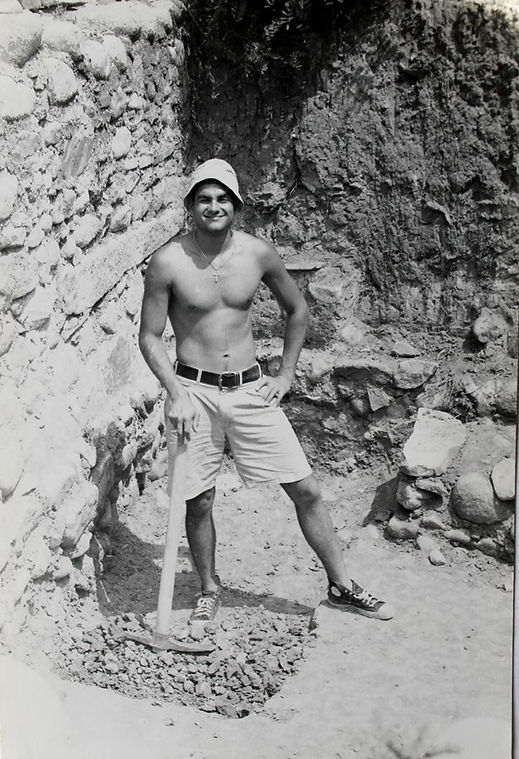
Ivo Tavityan started his practice in archaeology when he was just in the 8th grade. He heard that in one of Sofia’s neighborhoods - Slatina, a prehistorical village from the Neolithic period had been found. They were seeking seasonal workers and there was no age restriction, so Ivo went out of curiosity. "On these excavations, I saw a skeleton for the first time. Then I got hooked to archaeology."
After a few years, Ivo majored in History and Archaeology at the South-Western University in Blagoevgrad, Bulgaria. Every summer, during his studies he was doing a practice at the archaeological excavations of Sozopol's necropolis.
“Archaeology is a skill. In university, you can gain some knowledge about identifying or dating an artifact, but you become a real archaeologist only on the field.”
Fisrt encounters

In 2000, after his military service, Ivo started searching for a job in archaeology. He learned where the group of the famous Bulgarian archaeologist Ph.D. Georgi Kitov (1943 - 2008) was working. The place was Chetiniova Mound near the village of Starosel and one day Ivo just showed up there with a little backpack. Kitov told Ivo that he rarely took people, he didn’t know, but he gave him a chance. "He told me that after 2 weeks I would probably give up myself."
Kitov turned out to be right and Ivo was about to give up after a few days because work and living conditions were unbearable. They lived in an abandoned hotel, which yard was used as a dump.
“A few people knew the conditions we had to bare with. The smell from the dump was awful. In the hotel, we only had hot mineral water. When we got back from work at night we had to shower with this water, almost boiling ourselves alive. The first morning there, I expected breakfast with coffee. Nothing like that - we drank tee, while Kitov was distributing the tasks for the day, and then we went straight to the excavations.”
Despite all Ivo did not give up and part of it he explains with the fact that he was working with amazing people. “People in the expedition were dedicated not to wages, but to work itself. I understood that I was among individuals, for whom archaeology was a personal cause and life purpose.”
“We were having progress with our work. But then some strange events happened. Kitov’s colleagues from the Archaeological Institute started visiting our excavations and were trying to sabotage our work. They probably had connections with the Ministry of Culture, because after some time we got an order to leave the excavations within 10 days, without any definite explanation. And at that time we had already discovered various artifacts.”
Fortunately, the events in the following days had a positive outcome for Kitov’s expedition. Margarette II, Queen of Denmark, wrote a letter to Bulgarian President at that time Peter Stoyanov, saying that she wanted to visit Kitov’s excavations herself.
“It was a complete turn-around of events, we couldn’t believe what was happening. Work was resolved and we started preparing for the Queen's welcoming. After the visit, the Bulgarian government started funding archaeological work. For our next expedition in the village of Alexandrovo we were accommodated in a better hotel and we started receiving food and wages.”
In Alexandrovo, the team worked on the so-called “Saving excavations”, where the new highway was about to be constructed. On the 17th of December, 2000, the last morning of the excavations, the group went to collect their instruments and came across a bunch of leaves, covering a tunnel. It came out, that the tunnel was leading to the center of a mound. Ivo and a few others decided to enter. At that moment they had discovered the first chamber of the later famous Thracian Tomb of Alexandrovo.
“It was a complete shock. We lit our flashlights and we saw all these paintings.”
(iLoveBulgaria, 2018)
The group made a tremendous discovery for the culture and history of Bulgaria. However, this led to a one-year suspension for Kitov to take part in archaeological excavations, on the ground that he had entered the Thracian Tomb of Alexandrovo, without the permission of a higher instance.
“In archaeology, it used to be like that if you found something, they used to hate you, to envy you,” says Ivo.
Greatest discoveries

Anthony Georgieff(n.d)
2004 was the greatest year for Bulgarian archaeology and Kitov was the one to lead the most remarkable expeditions. “In a single year, we made so many discoveries, that usually take 50 years,” says Ivo.
“However, strange events and experiences continued to happen every day. One time, while we were working a person fired a gun on us from a nearby Lada Niva car. Another time our instruments got destroyed during the night and all tires of our cars were ripped off. I saw a lot of cruelty back then and it amazed me.”
“2004 was dynamic, we were having discoveries almost every week. But in August of that year, we made a significant one.” In the so-called Valley of the Thracian Kings, the group found Seuthes III's mask - the first-ever gold mask discovered on the territory of Bulgaria.
The group also discovered many tombs, that are now turned into touristic attractions. On 21st of September, 2004 in one of the biggest mounds on the Balkans “Golyama Kosmatka” (Big Hairy Mound) they found a large bronze head. The head also belonged to the Thracian King Seuthes III and the mound came out to be his tomb.

Excerpt from (Studiospotligh, 2014)
“The tomb was sealed, and we dug a tunnel for 13 days. There was a real danger of the tunnel to collapse, and for us to stay there forever. The work in the tunnel was extremely harsh, nobody was let to even talk. On the 3rd or 4th of October, however, the tunnel collapsed. The person that was digging in the front just threw his pick and froze like a statue. We saw that above him dirt started falling down and at that moment he screamed at us “Run!”. We flew out of the tunnel like bottle stoppers and heard a terrible crash behind us.”


A few days later when the group successfully managed to enter the tomb, they found several chambers, one of which with the funeral bed of the Thracian King Seuthes III. Inside, they found many relics among which was the famous gold oak laurel wreath.
Excerpt from (Golden Mask, 2009)
Back to the roots
In 2006, Ivo Tavityan makes his last archaeological excavation with Kitov’s group. At that time, he had already started a family and in the years to follow, up to 2016, he works for the National Historical Museum in Sofia.


“When a person has spent that many years working, outside of the city, outside of Sofia, the time he has to spend in the city gets harder and more difficult. Everybody that has ever had this kind of job always longs for the forest, mountains, the fields. During my years as an archaeologist, I realized that life outside has a much more interesting smell. It’s more real.”
Currently, Ivo is managing the only convenience store in the village of Svejen, near Plovdiv, where he moved to in 2016.
“Here you can feel the seasons and find beauty in each one of them. It’s different compared to the greyness that the city offers.”


Locals in front of Ivo's convenience store

“Bulgarian village should have a future. It gives an opportunity for the economy and tourism. Only the sanctuaries discovered around Svejen are already above 10. Here every walk you take in the forest leads to a discovery of old villages and fortresses. There are many places, that are yet to be discovered. The future of villages is entirely in our hands, if we are more rational, we would succeed in keeping them and their history alive.”